Memopezil Official Website › Blog › Panax Ginseng And The Cochrane Verdict
Panax Ginseng In Memopezil: What The Cochrane Review Found, And What The 90 mg Row Still Owes You
Panax ginseng is the smallest row on this panel by weight and the last one this website has written about in full. It also has the most focused clinical file of any row here: a Cochrane review on cognition, and a small cluster of trials on something the label does not mention at all — blood glucose. Both are worth reading before deciding what 90 mg is doing in a memory capsule.
The row, as printed
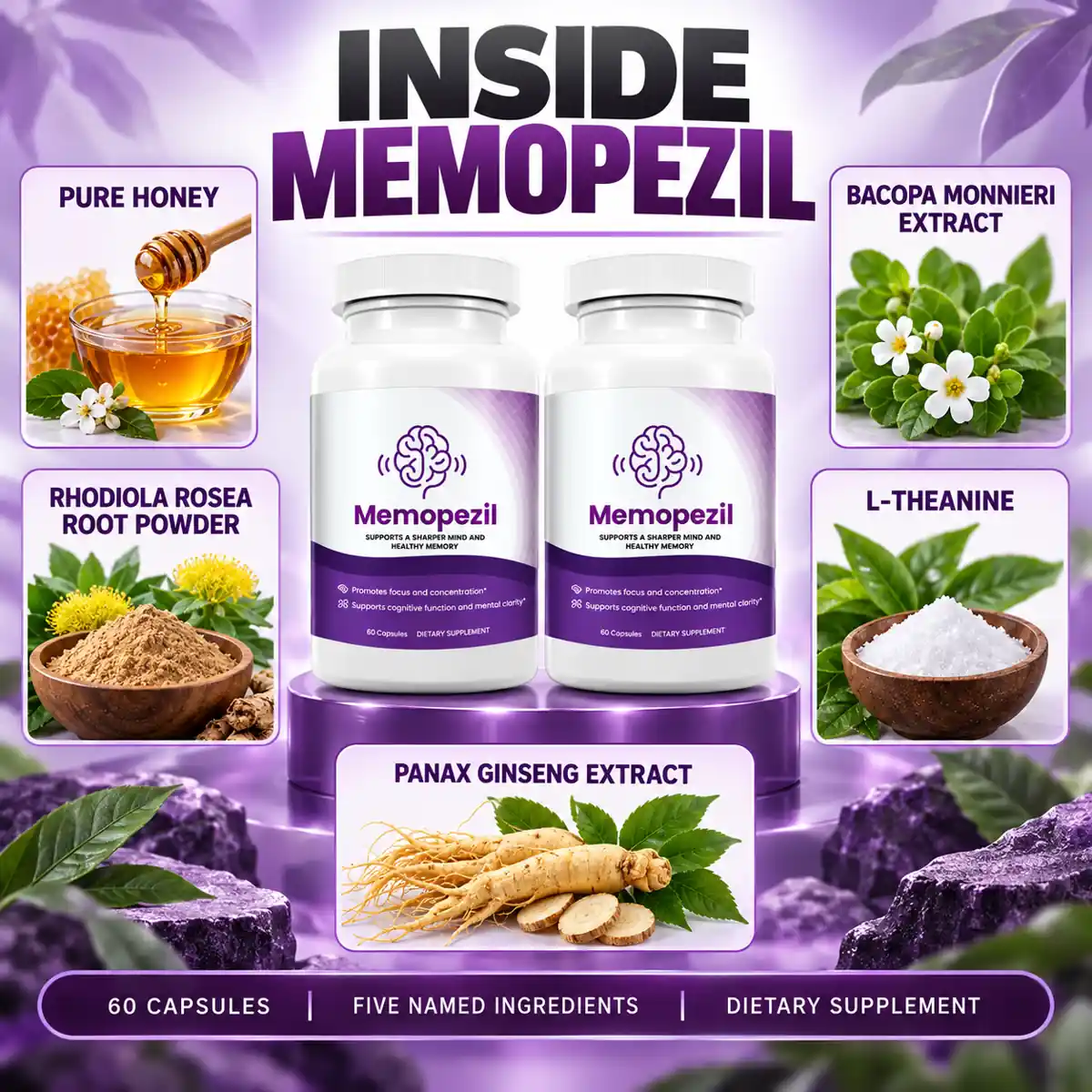
Panax Ginseng Extract sits fifth and last on the Memopezil Supplement Facts panel, at 90 mg per two-capsule serving — 45 mg per capsule, and about nine per cent of the active weight in the formula. No ginsenoside percentage is printed beside it, so the active-constituent strength of this particular extract is not stated on the label. That is worth knowing before anything else in this article, because every dose figure quoted below from published research is a dose of a specific, named extract (almost always Pharmaton's G115), and this label does not say whether its own extract is standardised the same way. The ingredients page sets that gap out for all five rows at once.
What the Cochrane review actually found
The single most useful document on ginseng and the brain is a Cochrane review, last substantively updated in 2010 and still the standing systematic word on the question. Geng and colleagues' Cochrane review searched every major trial database through February 2009 for randomised, placebo-controlled trials of ginseng on cognitive performance, in anyone.
Nine trials met the inclusion criteria. Only five had usable, extractable data. Four tested a ginseng extract; one tested a named ginseng compound. Pooling the results into a single number was impossible, because the trials differed too much in what they measured, how long they ran, and what dose they used. Read individually, the trials suggested improvement on some measures of cognitive function, behaviour and quality of life. No serious adverse events were reported.
The authors' own conclusion is worth quoting exactly, because it is more specific than most summaries of it: “there is a lack of convincing evidence to show a cognitive enhancing effect of Panax ginseng in healthy participants and no high quality evidence about its efficacy in patients with dementia.” That is not the same sentence as “ginseng does not work.” It is a sentence about the evidence, and what it says is that the evidence is not there yet, in either direction, for either population.
What “healthy volunteers” leaves out
Population is the detail almost every summary of this review drops, and it is the one that matters most for reading it honestly. Eight of the nine included trials enrolled healthy adults. Exactly one enrolled people with age-associated memory impairment. None of the nine looked at ginseng in people with a diagnosed cognitive disorder using evidence the reviewers judged high quality.
That means the Cochrane conclusion is really two separate findings wearing one sentence. In healthy people, several small trials exist and do not add up to convincing evidence either way. In anyone with actual memory impairment, the file is almost empty. A reader who takes “no convincing evidence in healthy participants” to also mean “proven not to help people with memory problems” is reading a claim the review never made, in the direction the review never tested.
Nothing about that gap is unique to ginseng. It is the same gap every ingredient on this panel has: a research base built almost entirely in healthy volunteers, for a product marketed to a much wider audience. The article on bacopa's twelve-week window runs into the same population question from a different angle.
The glucose story: four trials, one direction
Separately from cognition, one research group ran a focused set of trials asking a narrower question: does Panax ginseng change blood glucose, and does that explain any cognitive effect it has. The answer, across four separate papers from the same Northumbria University group, points the same way each time.
| Trial | Design | What it found |
|---|---|---|
| Reay 2005 | Single doses of G115 in healthy adults, cognitive tests after an overnight fast | 200 mg and 400 mg both improved a subtraction task and cut subjective mental fatigue; glucose fell |
| Reay 2006, Br J Nutr | Two crossover studies, 200 mg and 400 mg G115, fasted | G115 alone significantly lowered fasting blood glucose in both studies |
| Reay 2006, J Psychopharmacol | 200 mg G115 with and without a 25 g glucose drink | Ginseng improved a mental-arithmetic task and lowered glucose when taken without the drink |
| Shishtar 2014 | 1, 3 and 6 g Korean white ginseng, acute dose-escalation, in people with type 2 diabetes | 3 g reduced arterial stiffness; no clear effect on other glycaemic measures at these much larger doses |
Doses and findings read from the abstracts of the four papers cited at the foot of this article.
Three of the four trials used the same extract this label claims, G115, at 200 mg and 400 mg — roughly two to four and a half times this capsule's serving. All three found it lowered fasting blood glucose. The fourth used gram-scale doses of a different, steamed preparation in people who already have diabetes, and is included here mainly to show how much larger “ginseng doses studied in diabetes” can get; even at 1, 3 and 6 grams, the picture on glycaemic measures other than arterial stiffness was mixed rather than dramatic.
The authors of the first two papers put it plainly in their own conclusion: the findings “have implications for the use of ginseng in individuals with poor gluco-regulation.” That sentence, from researchers studying a cognition supplement, is really a caution about a metabolic effect that happens to arrive attached to a brain-focused capsule.
The dose arithmetic
| Where it was studied | Dose used | This label's 90 mg is… |
|---|---|---|
| Reay's cognition and glucose trials (G115) | 200–400 mg | 23–45% of the dose |
| Shishtar's type 2 diabetes trial (Korean white ginseng) | 1,000–6,000 mg | 1.5–9% of the dose |
| Cochrane's five extractable trials | Varied by trial; pooling was not possible | Not directly comparable, by the reviewers' own account |
Percentages are arithmetic against this label's printed 90 mg serving. They describe the gap between this product and the cited trials, not a claim about what dose would work.
Against the trials that most resemble what this capsule is for — single doses of a named extract, measuring cognition and glucose together in healthy adults — 90 mg sits under half the lowest dose tested. Against the diabetes trial's gram-scale doses, it is a rounding error. Neither comparison proves 90 mg does nothing; dose-response relationships in botanicals are not always linear, and nobody has run a trial at 90 mg to find out. It does mean the specific numbers in the table above — the ones behind every ginseng headline this category produces — were not generated at this amount.
- 90 mg on the panel, no ginsenoside percentage stated.
- 200–400 mg in the trials that tested the same G115 extract for cognition and glucose together.
- Eight of nine Cochrane-reviewed trials were in healthy adults; one was in age-associated memory impairment; none in dementia met the reviewers' quality bar.
- Every one of the four glucose-focused trials found ginseng lowered blood glucose at some point in the protocol.
Read the whole Memopezil panel before deciding about one row
Five actives, five printed amounts, and every one of them set against the dose its research used. The supplement facts page does the same arithmetic for the other four rows.
Two bottles $158 · six bottles $294 · 60-day money-back guarantee
Order MemopezilTwo capsules a morning · 60 per bottle
A caution worth reading if you take diabetes medicine
None of the four glucose trials above tested ginseng alongside insulin or an oral diabetes medication, so none of them can say what happens when a glucose-lowering botanical is combined with a glucose-lowering drug. That combination is exactly the one most likely to matter in practice, and it is the one the existing literature does not directly address.
The reasoning that follows is ordinary pharmacology rather than a finding from these specific papers: two agents that each lower blood glucose, taken together, are a plausible route to blood glucose going lower than either one would produce alone. Anyone on insulin, a sulfonylurea, or another glucose-lowering medicine has a specific reason to raise a five-ingredient capsule with a prescriber before starting it, and to watch for the ordinary signs of low blood sugar in the days after. This is caution built from the shape of the evidence, not a documented interaction case, and it should be read as exactly that.
What a fair reading looks like
Three things are true about this row at once, and none of them cancels the others.
It is not the weakest evidence base on the panel. A Cochrane review exists for ginseng and cognition. No comparable systematic review exists for the amino-acid blend that occupies over half this capsule's active weight, which the arithmetic on that row sets out in full.
It is not proven to help memory. “A lack of convincing evidence” in healthy adults, with almost nothing tested in anyone with actual cognitive impairment, is the accurate description, not “clinically studied for memory,” a phrase this website avoids for the same reason it avoids it elsewhere on this label.
It carries a metabolic effect the label does not mention. Four separate trials of the same extract class found it lowered blood glucose. That is not a defect in the ingredient; it is a property of it, and it is the single most useful thing in this article for a reader deciding whether to start the product.
Memopezil is a dietary supplement and not a medicine. Nothing on this page treats, prevents or slows any condition. Memory that is getting worse month by month, or that other people noticed before you did, is a reason to be assessed rather than a reason to start a capsule, and several of the common causes are treatable. The National Institute on Aging sets out the difference. Anyone managing diabetes with medication should talk to the prescriber before adding any glucose-active supplement, including this one.
References
- Geng J, Dong J, Ni H, et al. Ginseng for cognition. Cochrane Database Syst Rev. 2010;2010(12):CD007769. PMID 21154383. https://pubmed.ncbi.nlm.nih.gov/21154383/
- Reay JL, Kennedy DO, Scholey AB. Single doses of Panax ginseng (G115) reduce blood glucose levels and improve cognitive performance during sustained mental activity. J Psychopharmacol. 2005;19(4):357-65. PMID 15982990. https://pubmed.ncbi.nlm.nih.gov/15982990/
- Reay JL, Kennedy DO, Scholey AB. The glycaemic effects of single doses of Panax ginseng in young healthy volunteers. Br J Nutr. 2006;96(4):639-42. PMID 17010221. https://pubmed.ncbi.nlm.nih.gov/17010221/
- Reay JL, Kennedy DO, Scholey AB. Effects of Panax ginseng, consumed with and without glucose, on blood glucose levels and cognitive performance during sustained ‘mentally demanding’ tasks. J Psychopharmacol. 2006;20(6):771-81. PMID 16401645. https://pubmed.ncbi.nlm.nih.gov/16401645/
- Shishtar E, Jovanovski E, Jenkins A, Vuksan V. Effects of Korean White Ginseng (Panax Ginseng C.A. Meyer) on Vascular and Glycemic Health in Type 2 Diabetes: Results of a Randomized, Double Blind, Placebo-controlled, Multiple-crossover, Acute Dose Escalation Trial. Clin Nutr Res. 2014;3(2):89-97. PMID 25136536. https://pubmed.ncbi.nlm.nih.gov/25136536/