Memopezil Official Website › Blog › Who Should Think Twice
Who Should Think Twice Before Taking Memopezil: Five Ingredients, Five Interaction Questions
A five-active panel is not one ingredient question, it is five. Each row has its own published interaction file, and two of them — one bacopa case report and a run of ginseng glucose trials — are specific enough to name a medicine class by name. This article works through all five rows and says plainly who has a particular reason to ask a prescriber first.
Why one panel means five interaction questions
It is tempting to ask “does Memopezil interact with my medicine” as if it were one question with one answer. No trial has ever tested the finished five-ingredient formula against any drug, so no one can answer that question directly for the product as a whole. What does exist is a scattered but real research file on the individual rows, and reading it honestly means going row by row rather than reaching for one verdict.
Two rows have the most concrete evidence: bacopa and rhodiola both alter liver and gut enzymes that metabolise a wide range of prescription drugs, and ginseng has a repeated, specific effect on blood glucose. The other two rows have thinner files, which is a finding in itself and is reported as one below rather than skipped.
Bacopa: one case report and a CYP450 signal
Bacopa monnieri is the row this website has written about most, usually for its twelve-week memory trials. Separately from that literature, laboratory work has looked at what the extract does to cytochrome P450 enzymes — the liver and gut proteins that break down a large share of prescription drugs. A 2014 in-vitro study found that a standardised bacopa extract inhibited CYP2C19, CYP2C9, CYP1A2 and CYP3A4 in human liver cell preparations, at concentrations the authors estimated were reachable in the gut at an ordinary 300 mg daily dose. Drugs cleared by those same enzymes could plausibly build up to higher levels than expected if bacopa is slowing their breakdown.
That is laboratory evidence, not a clinical trial, and laboratory inhibition does not always translate into a meaningful effect in a person. What moves this from theoretical to concrete is a 2022 case report describing a 58-year-old woman on cevimeline, a drug for dry mouth in Sjögren’s syndrome, who developed hyperhidrosis, nausea and a fast heart rate — classic signs of too much cholinergic activity — after taking an herbal supplement containing bacopa the night before. Her symptoms resolved with fluids and stopping the supplement. The authors could find only one other documented cevimeline overdose in the literature, and this was the first tied to an herbal interaction.
One case report is one case report, not proof that this will happen to anyone else. It is, however, a real, published, named event rather than a hypothetical, and it is the clearest argument on this entire panel for telling a prescriber what supplements are being taken before starting a new one.
A second, older line of bacopa research is worth naming and hedging carefully in the same breath: a 2002 study in male mice found that a bacopa leaf extract raised T4 thyroid hormone levels by about 41 per cent, leading the authors to describe it as potentially thyroid-stimulating. This is animal data only, at an extract and dose that do not map cleanly onto a 200 mg human capsule serving, and nobody should read a mouse study as a finding about a person. It is a reasonable basis for one sentence, not a warning label: anyone on thyroid medication has a specific, if unproven, reason to mention bacopa to whoever manages that prescription.
Rhodiola: the same CYP450 story, different enzymes
Rhodiola rosea turns up on the root powder or standardised extract article for a labelling question. It belongs here for a different reason. A 2016 laboratory study tested six commercial rhodiola products against three human CYP enzymes — CYP3A4, CYP2D6 and CYP1A2 — and found real inhibition in every one of them, with the strength varying by product. CYP3A4 is the single enzyme responsible for clearing the largest share of prescription drugs on the market, from some statins to several anti-anxiety medicines, which makes this the broadest-reaching interaction question on the whole panel by sheer number of drugs it touches.
As with bacopa, this is in-vitro laboratory evidence, generated by exposing isolated human enzymes to the extract in a dish rather than by dosing a person and watching what happens. It establishes that the mechanism for an interaction exists and is measurable, not that any specific rhodiola-and-drug combination has been shown to cause harm in a clinical trial. Nobody has run that trial. The honest position is that this is a plausible, laboratory-supported reason for caution rather than a documented clinical event, which is also why it is reported here with a different confidence level than the bacopa case report above.
Panax ginseng: blood glucose, in four trials
Ginseng gets its own detailed treatment on this website's ginseng article, and the short version belongs here too. Four separate human trials of the same G115 extract class found that single doses lowered fasting blood glucose in healthy volunteers, at 200 mg and 400 mg. One of those papers states the implication directly: the findings “have implications for the use of ginseng in individuals with poor gluco-regulation.”
Nobody has tested ginseng alongside insulin or an oral diabetes medication in a controlled trial, so the specific combination cannot be described as proven dangerous. What can be said is that combining two things that each lower blood glucose, without medical supervision, is not a combination to discover by accident. Anyone managing diabetes with medication has a concrete, trial-supported reason to raise this ingredient specifically before adding it.
| Row | What the evidence shows | Strength of the evidence | Ask before combining with |
|---|---|---|---|
| Bacopa monnieri | CYP2C19/2C9/1A2/3A4 inhibition in vitro; one published case of cholinergic toxicity with a cevimeline user | One documented case report plus laboratory data | Cholinergic drugs (e.g. cevimeline, pilocarpine); possibly thyroid medication |
| Rhodiola rosea | CYP3A4/2D6/1A2 inhibition across six commercial products | Laboratory data only, no clinical case reports found | Drugs cleared by CYP3A4, a very large group |
| Panax ginseng | Lowers fasting blood glucose in four separate human trials | Repeated human trial data, no drug-combination trial | Insulin and oral diabetes medications |
| Amino acid blend (BCAA) | At 540 mg, well under typical daily dietary intake; no supplement-specific interaction literature found | Thin file; see the arithmetic article | No specific caution identified at this amount |
| L-theanine | Generally well tolerated across trial literature; no supplement-specific interaction study found in the search for this article | Thinnest file on the panel | No specific caution identified |
“No specific caution identified” describes what a search for this article found, not a guarantee that none exists. Absence of evidence is reported as absence of evidence, nothing stronger.
Read the panel, then talk to a prescriber if any row applies to you
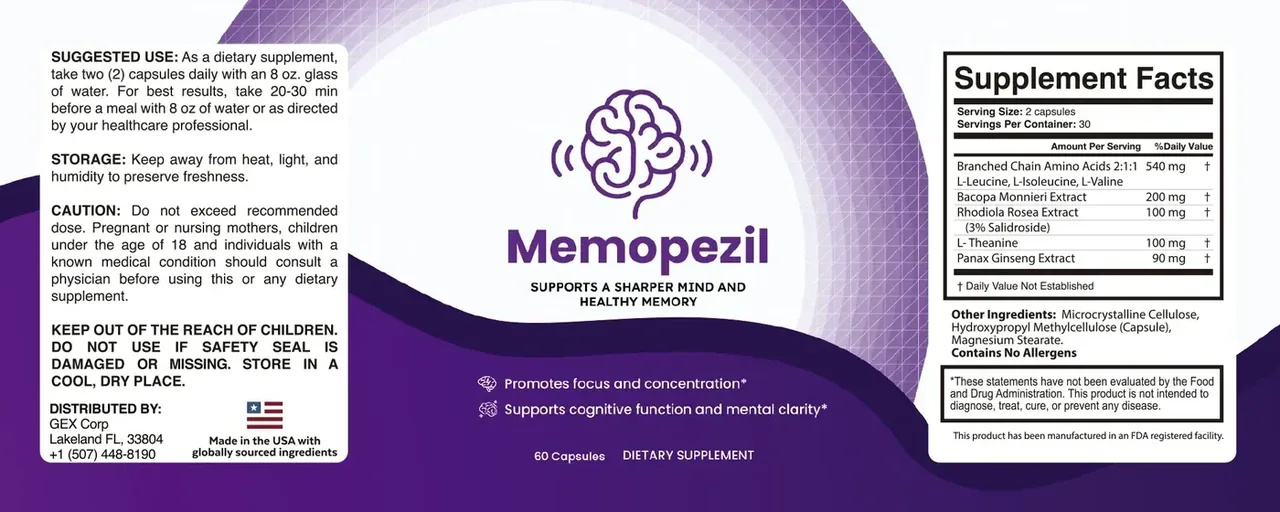
Five actives with every amount printed. The interaction questions above sit beside three of them; the ingredients page has the dose arithmetic for all five.
Two bottles $158 · six bottles $294 · 60-day money-back guarantee
Order MemopezilTwo capsules a morning · 60 per bottle
The two smaller files: amino acids and theanine
The branched-chain amino acid blend and L-theanine are worth naming precisely because their interaction files are thin, and thin is a real finding rather than a gap in this article's research. At 540 mg, the amino-acid row is a fraction of what an ordinary protein-containing meal supplies, which the dedicated article on that row sets out in full; a search of the published literature for this article did not turn up a supplement-dose interaction specific to that amount. L-theanine has a large trials literature for attention and calm, and a search for drug-interaction studies specific to the compound, as opposed to green tea generally, did not surface a clinical finding worth reporting here. Neither statement is a certificate of safety. It is a report of what a careful search did and did not find, which is the standard this whole article is trying to hold to.
Populations with a standing reason to ask first
Beyond the ingredient-specific questions above, several groups have a general reason to talk to a clinician before starting any five-ingredient botanical and amino-acid capsule, independent of which row is doing the work:
- Anyone on a prescription medication cleared by the liver, given the CYP450 findings for both bacopa and rhodiola above.
- Anyone managing diabetes with insulin or medication, given the ginseng glucose trials above.
- Anyone on a cholinergic or anticholinergic medication for dry mouth, glaucoma, urinary retention or a related condition, given the documented bacopa case report.
- Anyone on thyroid medication, given the animal-only bacopa thyroid data, reported here with its proper hedge rather than as a settled finding.
- Pregnant or nursing people, since none of the trials cited on this website enrolled pregnant participants and the label itself is written for other adults.
- Anyone under 18, for the same reason the label states plainly: this product is formulated and studied for adults.
- Anyone with an upcoming surgery, since several supplement categories are routinely paused before a procedure and a prescriber or surgical team is the right judge of timing, not a website.
How to have the conversation with a prescriber
The single most useful thing a reader can do with this article is bring it, or a short version of it, to an actual appointment. Three sentences cover most of what a prescriber needs: the five ingredient names and amounts from the Supplement Facts panel, the medications currently being taken, and the specific question — is there a reason to avoid or delay starting this, given what I take now. The supplement facts page has the panel in full, transcribed, for exactly this purpose.
A prescriber who has never heard of Memopezil by name can still answer the underlying question once the five ingredient names are in front of them, because bacopa, rhodiola, ginseng, L-theanine and a branched-chain amino acid blend are each individually recognisable compounds with their own literature, even when the finished product is not.
What a fair reading looks like
Three things are true together. Most of the interaction evidence here is laboratory or single-case, not large clinical trials, which is the honest state of herb-drug interaction research generally and not a defect specific to this product. Two rows — bacopa and ginseng — have specific enough evidence to name the exact medicine classes worth asking about, which is more precision than most supplement labels ever offer a reader. None of this replaces a conversation with whoever manages an existing prescription, and nothing in this article is written to substitute for one.
Memopezil is a dietary supplement and not a medicine. Nothing on this page treats, prevents, or diagnoses any condition, and nothing here is medical advice for an individual reader. Anyone taking a prescription medication, managing a chronic condition, pregnant, nursing, or under 18 should talk to a clinician before starting this or any supplement. The NIH Office of Dietary Supplements has general guidance on discussing supplements with a healthcare provider.
References
- Acquarulo B, Tandon P, Macica CM. Suspected cholinergic toxicity due to cevimeline hydrochloride and Bacopa monnieri interaction: a case report. J Med Case Rep. 2022;16(1):253. PMID 35765109. https://pubmed.ncbi.nlm.nih.gov/35765109/
- Ramasamy S, Kiew LV, Chung LY. Inhibition of human cytochrome P450 enzymes by Bacopa monnieri standardized extract and constituents. Molecules. 2014;19(2):2588-601. PMID 24566323. https://pubmed.ncbi.nlm.nih.gov/24566323/
- Kar A, Panda S, Bharti S. Relative efficacy of three medicinal plant extracts in the alteration of thyroid hormone concentrations in male mice. J Ethnopharmacol. 2002;81(2):281-5. PMID 12065164. https://pubmed.ncbi.nlm.nih.gov/12065164/
- Thu OK, Nilsen OG, Hellum B. In vitro inhibition of cytochrome P-450 activities and quantification of constituents in a selection of commercial Rhodiola rosea products. Pharm Biol. 2016;54(12):3249-3256. PMID 27572116. https://pubmed.ncbi.nlm.nih.gov/27572116/
- Reay JL, Kennedy DO, Scholey AB. The glycaemic effects of single doses of Panax ginseng in young healthy volunteers. Br J Nutr. 2006;96(4):639-42. PMID 17010221. https://pubmed.ncbi.nlm.nih.gov/17010221/
- Dietary Supplements: What You Need to Know. Office of Dietary Supplements, National Institutes of Health. https://ods.od.nih.gov/factsheets/WYNTK-Consumer/